
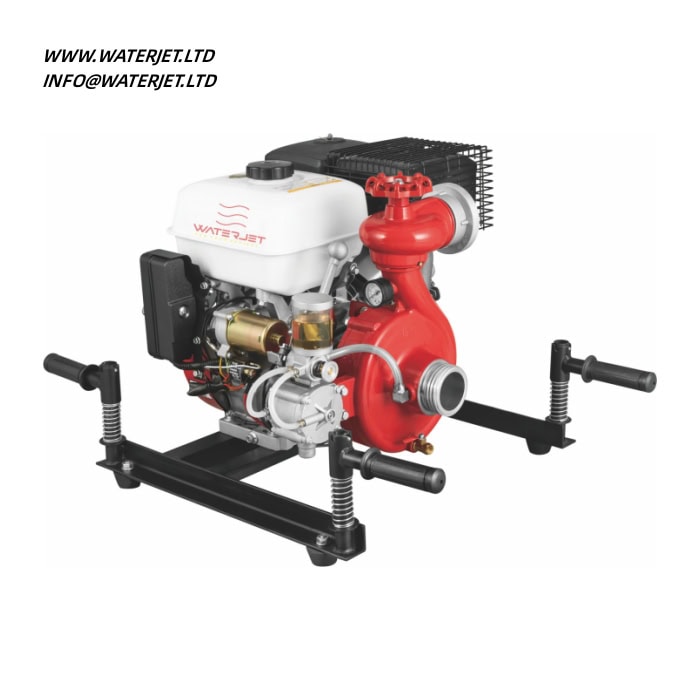
80 Metre Head Fire Pump 54 T/H – Gasoline Single-Stage Centrifugal Unit
The 80 metre head fire pump is a gasoline-engine-driven single-stage centrifugal pump quoted at 80 m of head and 54 T/H of flow, built for fire water supply, irrigation and emergency high-volume transfer.
80 m of head corresponds to roughly 8 bar of pressure, and 54 T/H is 54 m3/h, or 900 L/min. At that duty the hydraulic power is about 8 x 900 / 600 = 12 kW before pump losses, which shows why a petrol engine rather than a small electric motor drives this class of unit. The published description highlights high lift, large flow, durability, simple operation and fuel efficiency. This page sets out what those figures mean for a real installation and which data still needs to come from the factory.
Technical Specifications
| Parameter | Value | Note |
|---|---|---|
| Head | 80 metres (about 8 bar) | Stated in the product title; bar is a unit conversion |
| Flow | 54 T/H (54 m3/h, about 900 L/min) | Stated in the product title; L/min is a unit conversion |
| Pump type | Single-stage centrifugal | Stated in the product description |
| Drive | Gasoline engine | Stated in the product description |
| Estimated hydraulic power | About 12 kW at the quoted duty | Calculated as bar x L/min / 600 |
| Engine power and fuel consumption | Not published | Request the engine nameplate |
| Suction lift, inlet / outlet diameter | Not published | Needed for pipe and priming design |
| Pump curve and duty cycle | Not published | Required for system design |
Head, flow, pump type and drive come from the published title and description. Engine power, suction lift, port sizes, pump curve, materials, dry-running tolerance and duty cycle are not stated, so they are not invented. For life-safety installations, obtain the certified pump curve and the engine data sheet rather than sizing from the title alone.

Fire Water and High-Volume Transfer Duties
Fire Water Supply and Relay
A pump with 80 m of head can lift water to a fire-water tank, feed a hydrant or relay line, or supply a sprinkler main where the permanent system has failed. 900 L/min is a substantial volume, but actual delivered flow falls as the required head rises; the pump curve is essential for designing the pipework and choosing nozzle counts.
Irrigation and Bulk Water Transfer
Moving water from a reservoir, canal or tanker to fields or storage tanks is the same hydraulic problem as fire water: high volume at moderate head. diesel engine water pump quoted at 80-150 m3/h covers a related high-flow class; compare the two on the pump curve and engine data rather than on the headline numbers.
Flood Response and Site Dewatering
A petrol-driven unit can be trailered to a flooded site and started without mains power. Confirm suction lift and strainer arrangement before deployment, and plan for the noise and exhaust of an engine running for long periods near occupied areas.
Understanding Head, Flow and the 8 Bar Figure
Head is the height the pump can lift water, and 80 m is roughly 8 bar of static pressure. Friction in hoses, fittings and elevation changes all consume that head, so 80 m is not 8 bar available at the nozzle. Work from the pump curve: at a higher required head the delivered flow drops below 54 T/H, and at a lower head it can exceed it.
The hydraulic estimate of about 12 kW at the quoted duty is a check on plausibility, not an engine specification. The engine must deliver more than that after pump and transmission losses, and its rating should be confirmed from the nameplate. A pump sold for fire duty also needs a documented continuous running capability, which is not published here.
This is a high-volume, moderate-pressure machine, not a high pressure cleaner. 1000 bar marine water blaster at 25 L/min and 2800 bar hull preparation system at 48 L/min sit at the opposite end of the pressure-flow spectrum: a small fraction of this flow at two orders of magnitude higher pressure.
| Duty | Selection point | Equipment |
|---|---|---|
| Fire water, irrigation, flood transfer | 80 m head / 54 T/H | This machine |
| Higher-volume diesel transfer | 80-150 m3/h | diesel engine water pump |
| Car and yard washing | 70-150 bar at 5-8 L/min | portable washer, KQ-1008S washer |
| Hull cleaning and paint removal | 1000-2800 bar at 25-48 L/min | 1000 bar water blaster, 40000 psi water blaster |
Operating and Maintenance Notes
- Run the petrol engine outdoors or in a well-ventilated plant room; exhaust contains carbon monoxide.
- Prime the pump and suction line before starting; never run a centrifugal pump dry.
- Check engine oil, fuel, air filter and strainer before long runs, and log hours for servicing.
- Size suction and discharge pipework from the pump curve, including friction losses and elevation.
- For fire-safety use, obtain the certified curve and commission the installation with a flow test.

Frequently Asked Questions
What pressure does 80 m of head give?
About 8 bar at the pump, before pipe friction and elevation losses. Delivered pressure at the nozzle will be lower.
How much water does 54 T/H mean?
54 tonnes per hour is treated as 54 m3/h for water, or roughly 900 L/min.
Is the pump self-priming and what suction lift can it handle?
Neither figure is published. Confirm both with the factory before specifying a dry suction installation.
What engine power does it use?
Engine power is not published. The hydraulic estimate at the quoted duty is about 12 kW, but the nameplate rating and continuous-duty capability must come from the manufacturer.
Related Cleaning Equipment
the diesel engine water pump quoted at 80-150 m3/h and 500 bar wire braided high pressure hose and 1000 bar marine water blaster and 40000 psi / 2800 bar hull water blaster and 1500 bar ultra-high-pressure water blaster.
